
Most business owners think they’ve “done branding” once they have a logo, a few social media posts, and maybe a catchy line.
It feels like progress.
But then nothing really happens. People don’t remember the brand. Engagement stays low. Sales don’t grow the way they should.
The issue is not effort. It is direction.
Branding works when you build assets that improve recall, trust, and consistency over time.
If you are building a business, these are the five brand assets that actually make a difference.
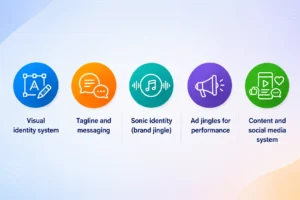
Quick Summary: The 5 Brand Assets
- Visual identity system
- Tagline and messaging
- Sonic identity (brand jingle)
- Ad jingles for performance
- Content and social media system
Each one plays a different role, but together they create a complete brand system.
1) Logo and Visual Identity System
Definition:
A visual identity system is a consistent set of colors, fonts, layouts, and design rules used across all brand touchpoints.
Key point:
A logo alone does not build brand recall. Consistent visual patterns do.
Why it matters
People do not remember brands easily. They remember repeated patterns.
When your brand looks the same across ads, website, packaging, and social media, it becomes easier to recognize. This reduces mental effort and improves recall.
That is why you can recognize brands like Apple or Zomato instantly, even without reading the name.
Where brands go wrong
- They design a logo and stop there
- Colors and fonts keep changing
- Social media posts look inconsistent
- Different teams interpret the brand differently
This breaks recognition.
How to execute better
- Fix a color palette and use it everywhere
- Limit fonts to one or two
- Define a clear image and layout style
- Create simple, usable brand guidelines
Clear takeaway:
Consistency in visuals increases recognition, and recognition increases trust.
2) Tagline and Messaging Framework
Definition:
A tagline is a short, memorable line that communicates your brand’s core promise, supported by a consistent messaging structure.
Key point:
If people do not understand your brand quickly, they will ignore it.
Why it matters
Your messaging helps people answer one question fast. Why should I care?
A strong tagline positions your brand clearly in the customer’s mind.
Examples:
- “Daag Ache Hain” reframed stains as a positive
- “Just Do It” represents action and intent
These work because they connect to a clear idea.
Where brands go wrong
- Using vague lines like “best quality”
- Copying competitors
- Changing messaging frequently
- No link between tagline and actual offering
This creates weak positioning.
How to execute better
- Define the exact problem you solve
- Write a simple, clear tagline
- Test if people can recall it easily
- Use the same messaging across all channels
Clear takeaway:
Clear messaging reduces confusion, and less confusion leads to better conversion.
3) Brand Jingle or Sonic Identity
Definition:
A sonic identity is a short, distinctive sound or tune that helps people recognize your brand through audio.
Key point:
Audio is processed faster and remembered longer than visuals.
Why it matters
People often scroll without paying full attention. But they still hear.
A consistent sound creates memory even in low-attention environments.
Examples:
- Airtel tune
- Intel sound
- Netflix intro
You recognize them instantly without seeing anything.
Where brands go wrong
- Ignoring audio branding
- Using different music in every video
- No consistent sound identity
This leads to zero audio recall.
How to execute better
- Create a short, simple, unique sound
- Use it in all ads and videos
- Keep it consistent over time
- Avoid frequent changes
Clear takeaway:
Repeated sound builds memory, and memory builds familiarity and trust.
4) Ad Jingles for Sales and Performance
Definition:
Ad jingles are short, repetitive audio messages designed to improve ad recall and drive conversions.
Key point:
A good ad jingle improves both recall and response in high-frequency advertising.
Why it matters
In performance marketing, repetition drives results.
A simple and repetitive jingle makes your product easier to remember when the customer is ready to buy.
This is why many local and D2C brands use highly repetitive audio lines.
Where brands go wrong
- Making jingles too complex
- Not mentioning the product clearly
- Focusing more on music than message
- No alignment with the offer
This reduces effectiveness.
How to execute better
- Keep it short and repetitive
- Include the product or brand name clearly
- Align it with your offer
- Test and optimize based on performance
Clear takeaway:
Simple and repetitive messaging increases ad recall and improves conversion rates.
5) Content and Social Media System
Definition:
A content system is a structured approach to consistently creating and distributing relevant content.
Key point:
Consistency in content builds familiarity, and familiarity builds trust.
Why it matters
People trust brands they see regularly.
If your brand shows up consistently with useful or relevant content, it stays top of mind.
That increases the chances of being chosen later.
Where brands go wrong
- Posting without a strategy
- Chasing every trend
- Inconsistent activity
- No connection between content and brand
This creates noise instead of impact.
How to execute better
- Define 3 to 4 clear content themes
- Choose formats that suit your audience
- Maintain a consistent posting schedule
- Balance trends with brand identity
Clear takeaway:
Consistent visibility increases trust, and trust increases long-term sales.
Why These 5 Brand Assets Matter Together
Each asset solves a different problem:
- Visual identity builds recognition
- Messaging builds clarity
- Sonic identity builds memory
- Ad jingles drive action
- Content builds consistency
Key point:
A strong brand is not one asset. It is a system of aligned assets.
If one is missing, the system weakens.
Example:
- Good ads but weak identity lead to poor recall
- Strong visuals but weak messaging lead to confusion
Alignment is what creates impact.
The Bigger Mistake Most Business Owners Make
Most people treat branding as a one-time task.
It is not.
Brand assets only work when they are used consistently over time.
Another common mistake is chasing trends instead of building systems.
- Trends give short-term attention
- Systems build long-term growth
Final Takeaway
If you are a business owner, ask better questions:
- Will people remember my brand?
- Will they recognize it quickly?
- Will it stay consistent over time?
Because branding is not about what you create once.
It is about what people remember every time they see or hear your brand.
When these five assets are built and used correctly, your brand becomes easier to recall, easier to trust, and easier to choose.